Neywa Labs, the local AI company behind Nativ, builds MLX-Audio, a library for running audio models on Apple Silicon (GitHub).
What the library covers
The project page describes MLX-Audio as a way to run audio models on Apple Silicon.
Its stated scope is four task types: text-to-speech, speech-to-text, speech-to-speech and music generation. The project page names MLX as the framework it is built on.
The maintainer is Neywa Labs, which calls itself a local AI company and names Nativ as another of its projects. For a practitioner, the useful reading is that one library groups several audio task types under a single Apple-focused runtime, instead of one tool per task. This article looks at two of the text-to-speech models whose documentation pages we read, not at the whole list.
ZONOS3-Mini
The README presents ZONOS3-Mini as Zyphra’s multilingual text-to-speech model (GitHub). ZONOS3-Mini has 100 million active parameters, according to the README. It generates 44.1 kHz mono audio with 27 built-in voices.
Because the figure for ZONOS3-Mini is an active-parameter count, it describes the parameters in use and should be read as such when comparing sizes with other models. The 27 built-in voices of ZONOS3-Mini give a user a set of ready voices to choose from.
Audio8-TTS-Realistic-0.6b
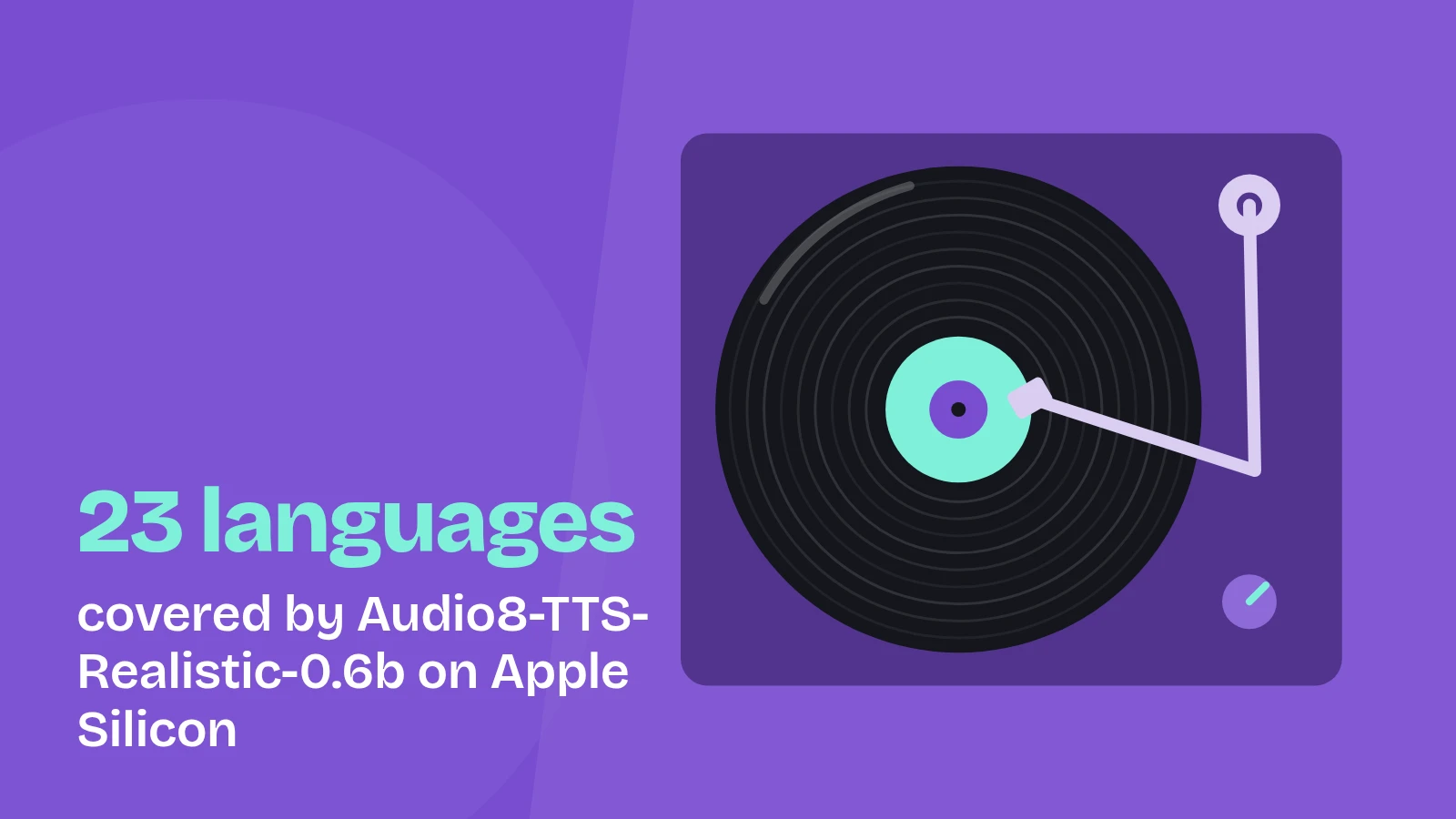
A separate documentation page covers Audio8-TTS-Realistic-0.6b (GitHub). It generates mono speech at 44.1 kHz in 23 languages on Apple Silicon, with optional zero-shot voice cloning. For Audio8-TTS-Realistic-0.6b, text tokens, reference audio frames and generated frames all share a 2,048-position context budget. The Audio8 documentation also says generation produces one complete waveform per call.
The shared budget has a practical consequence for voice cloning with Audio8-TTS-Realistic-0.6b. Because reference audio frames count against the same 2,048 positions as the text and the output, a longer reference clip leaves less room for the speech being generated. Anyone planning long passages would therefore split the text into chunks and keep the reference clip short. Since each call returns one complete waveform, the chunks would come back as separate files to join afterwards.
How the two models compare
Both ZONOS3-Mini and Audio8-TTS-Realistic-0.6b output mono audio at 44.1 kHz, so their output format matches. The differences lie elsewhere.
ZONOS3-Mini is described by its 100 million active parameters and 27 built-in voices. Audio8-TTS-Realistic-0.6b is described by its 23 languages, optional zero-shot cloning and a 2,048-position context budget. The first is framed around a ready set of voices, the second around language coverage and a hard limit on how much text and reference audio fit in one call.
This is our reading of the documentation pages. The pages give specifications, so they support a comparison of features and not of audio quality.
What to take from it
For someone choosing a local text-to-speech model on a Mac, the library’s value is that both models sit behind the same project. A reader who needs a set of ready voices would start from the ZONOS3-Mini page and its 27 built-in voices. A reader who needs many languages would start from the Audio8-TTS-Realistic-0.6b page and its 23 languages. In both cases the output is 44.1 kHz mono, so downstream audio handling can stay the same whichever model is picked.
Anyone planning long narration should read the Audio8 context budget before choosing a workflow, because it shapes how text and reference clips are prepared. Neywa Labs presents the library as a local option, and the model pages are where the concrete limits appear.
Sources
The sources this article was written from. Links open the original page.
- GitHubNeywa-Labs/mlx-audio: A text-to-speech (TTS), speech-to-text (STT) and speech-to-speech (STS) library built on Apple's MLX framework, providing efficient speech analysis on Apple Silicon.github.com
- GitHubNeywa-Labs/mlx-audio: releases, tags and changeloggithub.com
- GitHubLicence or terms of use linked by https://github.com/Neywa-Labs/mlx-audiogithub.com
- GitHubREADME.mdgithub.com
- GitHubaudio8.mdgithub.com